
Assessment
Understanding your symptoms, diagnoses, and previous medical history, and reviewing old medical records are the first steps.
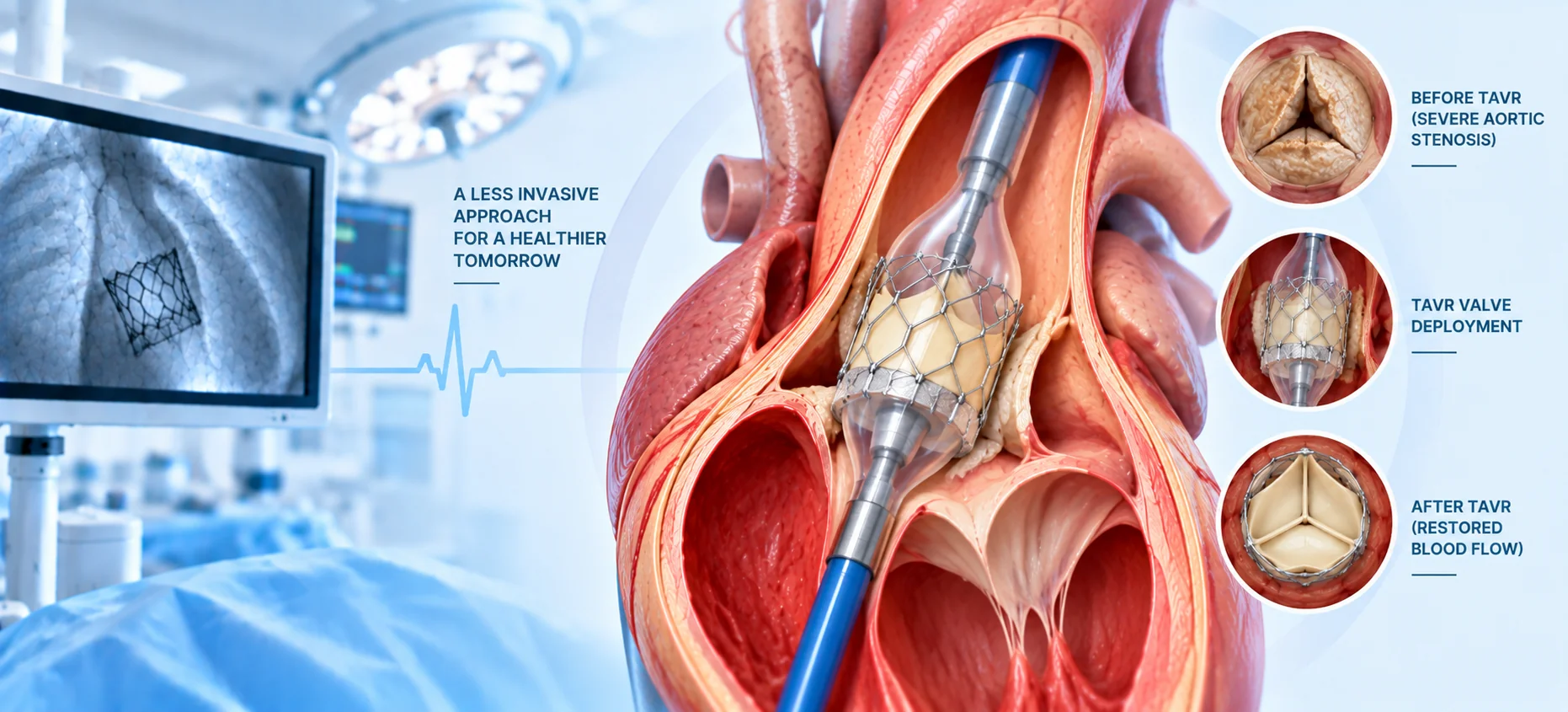
TAVR, also called TAVI, is a catheter-based procedure used to replace a diseased aortic valve in appropriately selected patients.
Instead of removing the existing valve through traditional open-heart surgery, a replacement valve is delivered through a catheter and positioned within the existing valve.
The entire procedure is performed in a knife-less suture-less fashion, without any major cut or incision. In the majority of cases, general anaesthesia and ventilator support are not required, making the procedure safer. Other heart valves can be treated with a similar catheter-based minimally invasive fashion.
These are called Transcatheter Mitral Valve Replacement (TMVR), Transcatheter Pulmonary Valve Replacement (TPVR), and Transcatheter Tricuspid Valve Replacement (TTVR) for the mitral, the pulmonary, and the tricuspid valve respectively.
Suitability depends on the severity of aortic valve disease, symptoms, age, overall health, anatomy and assessment by the treating heart team.
Understanding your symptoms, diagnoses, and previous medical history, and reviewing old medical records are the first steps.

A detailed CT scan, with additional tests as indicated, helps determine the appropriateness of the case and valve selection.
The planned procedure is executed in the cardiac cath lab, under conscious sedation, with continuous cardiac monitoring, anaesthesia support, and cardiac surgery backup.
Clinical evaluation and cardiac imaging help determine the severity of aortic valve disease and suitability for the procedure.
Imaging and anatomical assessment are used to plan the access route and select an appropriate valve.
The replacement valve is delivered through a catheter and deployed within the diseased aortic valve.
After the procedure, the heart team monitors recovery and valve function and provides follow-up guidance.
As with any medical procedure, TAVR/TAVI has potential risks and benefits. The appropriate approach should be decided after an individual clinical assessment.
A personalised consultation can help you understand your diagnosis, available options and the next appropriate step.
Clear answers to common questions about symptoms, evaluation and treatment.
View All FAQs →Aortic stenosis is narrowing of the valve that controls blood flow from the main chamber of the heart (left ventricle) into the aorta. Severe narrowing makes the heart work harder to pump blood to the body.
The commonest cause in older adults is age-related calcification. Other causes include bicuspid aortic valve (birth anomaly) and, less commonly today, rheumatic disease.
Typical symptoms are breathlessness, chest discomfort, reduced exercise capacity, dizziness or fainting, and heart-failure symptoms such as swelling.
Yes. Some patients remain apparently asymptomatic despite severe narrowing, so careful exercise history, echocardiography, and sometimes exercise testing are important.
Medicines may relieve associated symptoms or treat other conditions, but they do not open a severely narrowed aortic valve. Definitive treatment is valve replacement when indicated.
Clear answers to common questions about symptoms, evaluation and treatment.
View All FAQs →TAVR/TAVI is a minimally invasive procedure in which a replacement aortic valve is delivered through a catheter, most commonly through an artery in the groin, without open-heart surgery. The procedure is done just like an angioplasty.
Yes. TAVR means transcatheter aortic valve replacement and TAVI means transcatheter aortic valve implantation; they refer to the same treatment.
TAVR avoids opening the chest and usually avoids a heart-lung machine, resulting in faster recovery. Surgical replacement remains preferable in some patients depending on age, anatomy, and associated disease.
Suitability depends on severe symptomatic aortic stenosis, age, surgical risk, valve anatomy, vascular access, life expectancy, and patient preference. Decisions are ideally made by a multidisciplinary heart team.
No. TAVR is now used across a broad age and risk range, but younger patients require careful consideration of valve durability, coronary access, future procedures, and lifetime valve strategy.
