
Assessment
Understanding your symptoms, diagnosis and treatment goals is the first step.
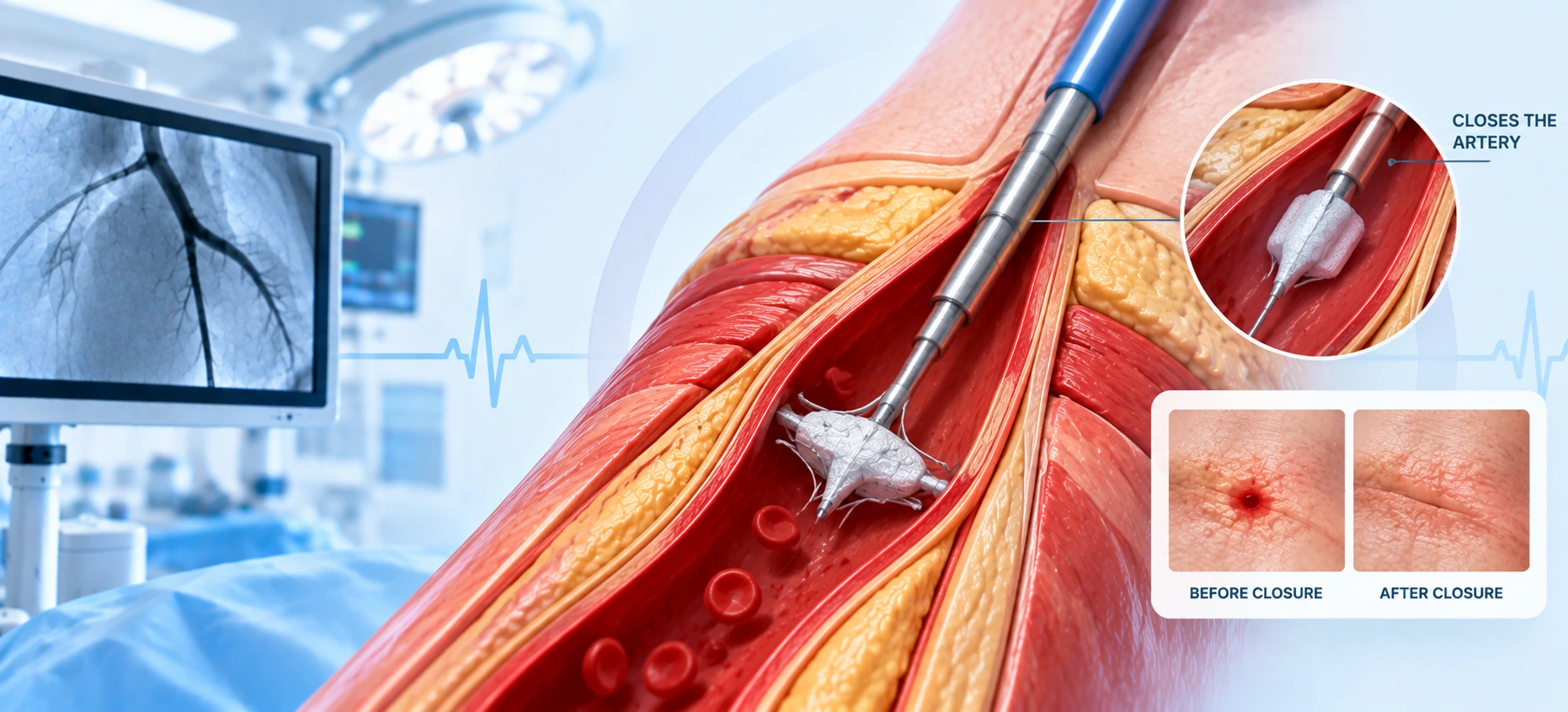
Percutaneous vascular closure techniques are used to help close the access site in a blood vessel after selected catheter-based procedures.
Depending on the procedure and access site, an appropriate closure method may support haemostasis and patient recovery.
The choice of closure technique depends on the procedure performed, access site, vessel characteristics and the patient's clinical circumstances.
Understanding your symptoms, diagnosis and treatment goals is the first step.

Imaging, anatomy and clinical findings help determine the appropriate approach.
The selected catheter-based technique is performed with continuous clinical monitoring.
The vascular access site is assessed before selecting an appropriate closure strategy.
Once the catheter-based procedure is completed, the access site is prepared for closure.
A suitable percutaneous closure method may be used to achieve haemostasis.
The access site is monitored for bleeding, discomfort and other potential complications.
Not every patient or access site is suitable for every closure technique. The approach is selected individually.
A personalised consultation can help you understand your diagnosis, available options and the next appropriate step.
Clear answers to common questions about symptoms, evaluation and treatment.
View All FAQs→It is a method of sealing the puncture in a blood vessel after a catheter-based procedure, often using a vascular closure device.
It helps stop bleeding at the access site and may allow earlier movement after the procedure compared with manual pressure alone.
Depending on the device, a plug, seal or suture closes the puncture where the catheter entered the vessel.
No. Suitability depends on the puncture location, vessel size and condition, and the procedure performed. Manual pressure may be preferred in some cases.
Risks include failure to seal the puncture, bleeding and, less commonly, blockage of the treated artery. The team monitors the access site after the procedure.
